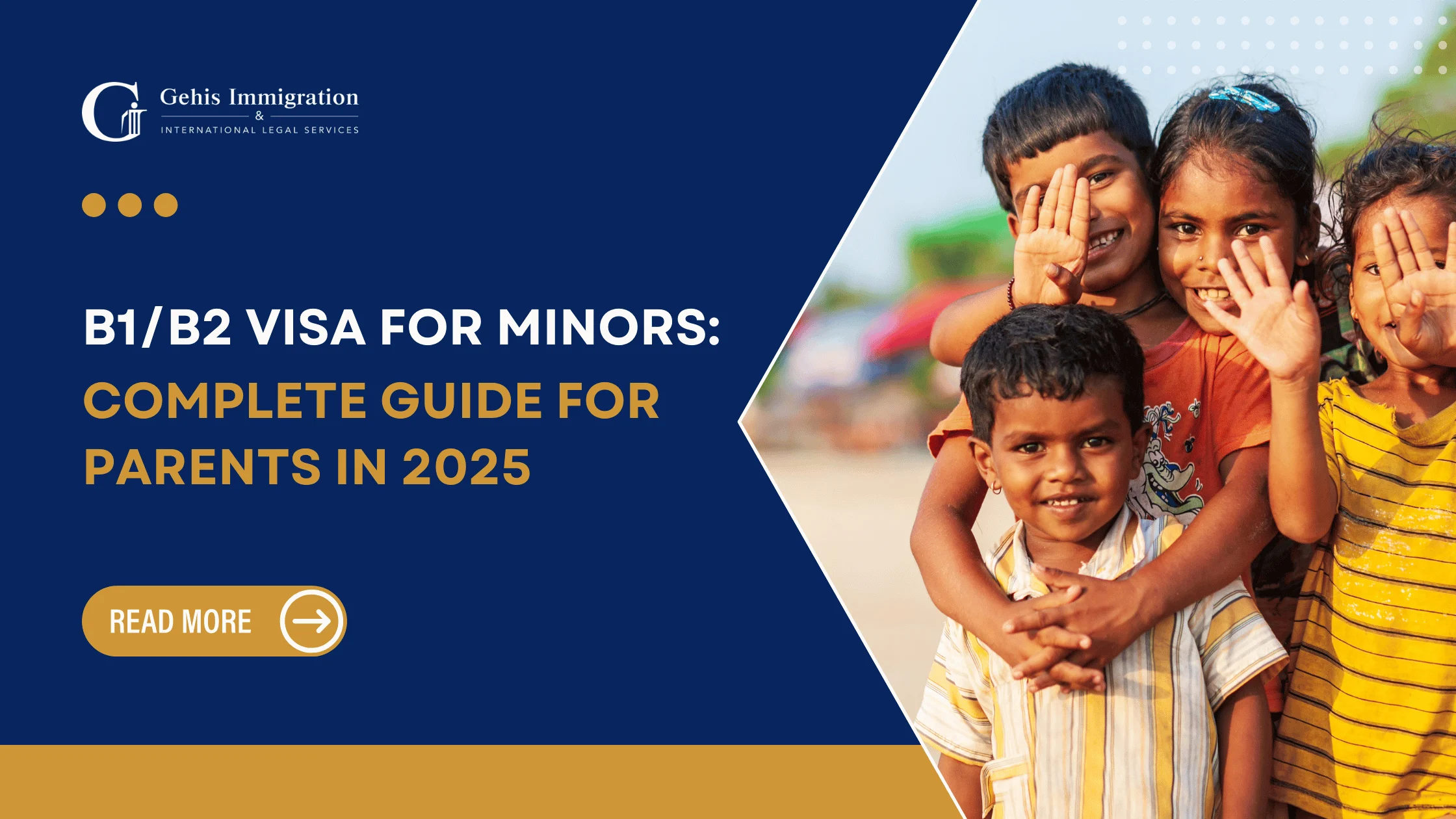
The B1/B2 visa is a U.S. nonimmigrant visa for temporary travel, covering business (B1) and tourism, medical treatment, or family visits (B2). While commonly associated with adult travelers, this visa category is equally relevant for children and minors who need to travel to the United States for short-term, lawful purposes. Families seeking professional guidance may benefit from structured B1/B2 tourist visa services to ensure proper documentation and compliance with U.S. immigration requirements.
Parents are increasingly applying for B1/B2 visas for minors due to greater international mobility, cross-border family connections, and the growing number of children traveling for short durations. Many families require visas for children to accompany parents on business trips, attend important family events, receive specialized medical care, or participate in short recreational or cultural visits.
Common scenarios where a B1/B2 visa for a minor is appropriate include visiting close family members in the United States, tourism during school holidays, medical consultations or treatment, and travel where a child accompanies a parent holding a B1 or B2 visa.
In limited circumstances, children may also travel with a parent on a short business trip, provided the child does not engage in any prohibited activities such as schooling or employment.
In 2026, correct visa planning for minors has become more critical than ever. U.S. immigration authorities closely examine factors such as parental intent, financial sponsorship, travel history, and the child’s ties to the home country. Even for infants and young children, applications must clearly demonstrate temporary intent and compliance with U.S. immigration laws. Errors or incomplete documentation can lead to delays or refusals, impacting family travel plans.
Gehis Immigration and International Legal Services assists families at every stage of the B1/B2 visa process for minors. From assessing eligibility and preparing accurate applications to ensuring compliance with evolving consular standards, we provide strategic, family-focused legal guidance. With a deep understanding of U.S. visitor visa regulations, Gehis Immigration and International Legal Services helps parents in the process confidently, minimizing risks and ensuring their child’s travel to the United States is lawful and well-planned.
What Is a B1/B2 Visa for Minors?
A B1/B2 visa for minors is a U.S. nonimmigrant visitor visa issued to children, including infants, for temporary travel to the United States. Like adults, minors must hold their own individual visas; a child cannot travel on a parent’s visa. The purpose of this visa is strictly limited to short-term stays and does not permit long-term residence, schooling, or employment. When properly issued, the B1/B2 visa allows a minor to enter the United States for clearly defined, lawful activities in accordance with U.S. immigration regulations.
The B1 and B2 categories serve distinct purposes, even when issued to minors. A B1 visa is primarily for business-related travel, such as accompanying a parent who is visiting the U.S. for meetings, conferences, or contract-related activities. In these cases, the minor is not engaging in business personally but is traveling as part of the family unit. A B2 visa, which is more commonly issued to children, covers tourism, visiting family and friends, medical consultations or treatment, and recreational travel. Most minor applicants are approved under the B2 classification, as children typically travel for personal or family-related reasons rather than business.
Under U.S. immigration law, the B1 B2 visa for minors is entirely permissible as long as the application establishes temporary intent and meets all documentary and eligibility requirements. U.S. consular officers evaluate minor applications based mainly on the parents’ circumstances, including financial stability, immigration history, and ties to the home country. For infants and young children, the analysis focuses on the parents’ intent and travel compliance rather than the child’s independent ties.
It is important to understand when a B1/B2 visa is appropriate and when another visa category is required. A B1/B2 visa is suitable for short visits such as family trips, tourism, or medical care. However, if a minor intends to enroll in a U.S. school, participate in a long-term academic program, or live in the United States for an extended period, a student visa (F-1 or M-1) or a dependent visa (such as F-2, H-4, or L-2) may be required instead. Applying for a B1/B2 visa when the actual purpose is long-term study or residence can lead to visa denial and future immigration complications.
The proper use of a B1/B2 visa for minors is essential to ensuring compliance with U.S. immigration laws and avoiding unnecessary refusals or delays. Professional legal guidance can help parents select the correct visa category and present a straightforward, truthful application aligned with the child’s travel purpose.
Eligibility Criteria for B1/B2 Visa for Minors
Applying for a B1/B2 visa for minors requires meeting specific eligibility criteria set by U.S. immigration authorities. While children are evaluated differently from adults, consular officers still expect clear documentation, lawful travel intent, and evidence of parental responsibility. Below are the eligibility requirements every parent should understand before applying.
Age Requirements and Eligibility Norms
There is no minimum age for applying for a B1/B2 visa; infants, toddlers, school-aged children, and teenagers are all eligible. Even newborns require their own passport and visa to enter the United States.
Eligibility norms for minors focus primarily on:
- The legitimacy of the travel purpose
- The intent to return home after the visit
- Proper guardianship and parental authorization
- The family’s ability to financially support the trip
Citizenship and Passport Requirements for Minors
A minor must hold a valid passport from their country of citizenship to qualify for a B1/B2 visa. Passport requirements include:
- Minimum validity of six months beyond the intended stay (unless exempt under country-specific agreements)
- Inclusion of the child’s full legal name and date of birth
- A passport that is machine-readable and meets international travel standards
Legal Guardianship and Parental Consent Considerations
U.S. immigration authorities closely scrutinize guardianship and consent matters to prevent unauthorized or unsafe travel. Required considerations include:
- Both parents’ consent is typically required when a child is applying for a visa
- If one parent is absent, a notarized consent letter or legal authorization may be needed
- In cases of divorce, custody agreements or court orders must be provided
- Guardians or relatives accompanying the child must show legal authority or permission
Financial Sponsorship by Parents or Guardians
A minor must demonstrate that the trip is financially supported by a legitimate source usually the parents or legal guardians. Evidence may include:
- Bank statements
- Income proof or employment letters
- Tax returns
- Sponsor letters explaining who is funding the trip
Financial sponsorship must match the stated travel purpose and duration. Consular officers particularly check for:
- Ability to cover travel and stay
- Transparent financial history
- Consistency between the sponsor’s information and the child’s DS-160 form
Proof of Strong Ties to Home Country for Minor Applicants
Since minors cannot independently demonstrate economic or social ties, consulates evaluate ties based on the parents’ and family’s circumstances. Strong ties may be demonstrated through:
- Parents’ employment or business commitments
- Ongoing schooling for the child
- Family property ownership
- An extended family residing in the home country
- Previous compliant travel history
Infant Visa for USA: Special Considerations
Traveling to the United States with a newborn or very young child requires careful planning and strict compliance with U.S. immigration rules. While there is no separate visa category formally labeled as an “infant visa,” infants must still obtain an appropriate nonimmigrant visa, most commonly a B1/B2, for short-term travel. Below are the considerations parents should understand when applying for an infant visa for the USA in 2026.
What Qualifies as an Infant Visa for the USA
An infant visa for the USA generally refers to a B1/B2 visitor visa issued to a child under 2 years old. U.S. immigration law does not exempt infants from visa requirements. Regardless of age, every child traveling internationally to the United States must have:
- An individual passport, and
- A valid U.S. visa, unless visa-exempt under specific nationality rules
Applicability of B1/B2 Visas for Newborns and Infants
B1/B2 visas are commonly issued to newborns and infants for:
- Family visits
- Short-term tourism
- Accompanying parents on temporary U.S. travel
- Medical consultations or treatment
In infant cases, U.S. consular officers focus entirely on the parents’ intent, travel history, and financial capacity. Since infants cannot form independent intent, the success of the application depends on whether the parents can clearly demonstrate that the stay will be temporary and compliant with visa rules.
It is important to note that a B1/B2 visa does not allow:
- Birth tourism to obtain U.S. citizenship
- Long-term residence
- Enrollment in daycare or educational programs
Documentation Required for Infants
Infant visa applications require precise and complete documentation. Commonly required documents include:
- The infant’s passport
- Birth certificate establishing parent-child relationship
- Parents’ passports and visas (if applicable)
- DS-160 confirmation page
- Visa fee receipt and appointment confirmation
- Consent letters if one parent is not traveling
- Medical documents if travel is treatment-related
Documents Required for a B1/B2 Visa for Minors
Preparing the correct documentation is essential for a smooth, successful B1/B2 visa application for minors. U.S. consulates carefully review paperwork to verify identity, intent, guardianship, and financial support. Even minors, including infants, must submit a complete set of documents. Below is a comprehensive, organized outline of all required documents for a minor visa application in 2026.
Mandatory Documents Checklist
A complete minor B1/B2 visa application must include the following core documents:
- Valid minor’s passport
- DS-160 form confirmation page
- Visa appointment confirmation
- Photograph
- Applicable parental/guardian documents
- Proof of financial capability
- Evidence supporting travel intent
- Consent documentation, if required
Minor’s Passport
The child’s passport must:
- Be valid for at least six months beyond the intended U.S. stay (unless exempt)
- Contain the child’s full name, birth details, and photograph
- Be machine-readable and in good physical condition
DS-160 Confirmation Page
- The DS-160 is the official visa application form.
- For minors, it is filled out by a parent or legal guardian.
- Ensure all information matches supporting documents, including names, dates, and family details.
- The barcode and confirmation page must be printed and brought to the appointment.
Visa Appointment Confirmation
- After payment of the MRV fee, parents must book the visa appointment.
- The appointment confirmation page is mandatory for entry to the consulate or biometrics center.
- Minors may be eligible for interview waivers, depending on age and local consulate policy.
Parental Documents
Consular officers review parental documentation to assess intent, financial capability, and legal guardianship.
Required documents typically include:
- Passports of both parents
- U.S. visas of parents (if they currently hold visas)
- Employment letters or business registration documents
- Proof of family’s financial stability
- Additional forms, if one parent is not available for the appointment or travel
Parents’ Passports and Visas
- Copies of the bio page of each parent’s passport
- Copies of valid U.S. visas held by the parents
- If parents are U.S. citizens or LPRs, proof such as:
- Green card copy
- U.S. passport copy
Proof of Legal Relationship (Birth Certificate/Adoption Papers)
This is one of the most crucial documents for minors.
Provide:
- Original birth certificate
- Adoption decree (if applicable)
- Court orders for legal guardianship
- Certified translations if documents are not in English
Financial Documentation
Since minors cannot support themselves, financial support is provided by their sponsor, usually a parent.
Recommended financial documents include:
- Bank statements from the last 6–12 months
- Income tax returns
- Salary slips
- Employment letters
- Affidavit of sponsorship (optional but helpful)
- Evidence of assets, if relevant
Travel Itinerary and Intent Documentation
These documents help establish temporary travel intent and may include:
- Detailed travel itinerary
- Round-trip flight reservations (optional but helpful)
- Hotel bookings or U.S. host invitation letters
- Medical appointment letters (for medical travel)
- Family event invitations (if applicable)
Consent Letters for Single-Parent or Guardian-Assisted Travel
If only one parent is applying or traveling with the child, the consulate may require:
- A notarized consent letter from the non-traveling parent
- Court custody documents in case of separation or divorce
- Death certificate (if applicable)
- Police or government-issued documentation in complex cases
Step-by-Step Application Process for B1/B2 Visa for Minors
Applying for a B1/B2 visa for minors follows a structured process similar to that for adult applications, but with age-specific accommodations and additional parental involvement. Careful attention to each step is essential to avoid delays, refusals, or processing complications in 2026.
Completing the DS-160 Form Accurately for Minors
The DS-160 non-immigrant visa application serves as the foundation for the minor’s visa case.
- A parent or legal guardian must complete the form on behalf of the child.
- All information must exactly match the child’s passport and supporting documents.
- Parents should clearly state the temporary purpose of travel under the B2 (or B1/B2) category.
- Travel history and parental details must be consistent with previous applications.
Paying the Visa Fee and Scheduling the Appointment
After submitting the DS-160:
- The nonrefundable visa application (MRV) fee must be paid.
- Parents must schedule the visa appointment through the official U.S. visa scheduling system.
- In some cases, minors may qualify for an interview waiver, eliminating the need for an in-person interview.
Visa Appointment Requirements for Minors by Age Group
U.S. consular requirements differ based on a child’s age:
- Infants and very young children: Often not required to attend interviews or biometrics
- Children under a specified age threshold: May qualify for interview waivers
- Teenagers: More likely to be asked to participate in an interview, often accompanied by a parent
Biometrics and Interview Waiver Eligibility
Many minors qualify for interview waiver programs in 2026, depending on:
- Age
- Previous visa history
- Nationality and consular policy
If biometrics are required:
- Fingerprints may be waived for young children
- Photographs must still meet U.S. visa standards
Consular Interview Process When Required
When an interview is required:
- A parent or legal guardian is usually allowed—and often required—to accompany the minor.
- The consular officer may ask questions about:
Purpose of travel
Length of stay
Parents’ employment and financial status
Ties to the home country.
Role of Parents During the Application Process
Parents play a central role throughout the minor’s visa application, including:
- Providing accurate and truthful information
- Submitting all required documents
- Demonstrating sufficient financial support
- Clarifying travel plans and intent
- Ensuring compliance with visa conditions after approval.
B1/B2 Visa for Minors: Validity and Duration of Stay
Understanding the validity, permitted entry duration, and rules for extending a child’s stay under the B1/B2 visa is crucial for lawful travel to the United States. Many parents confuse visa validity with the authorized stay period, leading to unintentional overstays. Below is a detailed explanation of how validity and duration work for minors in 2026.
B1/B2 Visa for Minors Validity Explained
When issued to minors, a B1/B2 visa generally has the same validity as a visa issued to an adult.
Typical validity can range from:
- 1 year
- 5 years
- 10 years (most common for countries with reciprocal agreements)
Extension of Stay Options for Minors Inside the U.S.
Parents may request to extend the child’s stay under certain circumstances by filing Form I-539 with USCIS.
Extensions may be granted for:
- Medical treatment
- Extended family visits
- Unforeseen travel complications
- Genuine need to remain temporarily
Conditions for approval include:
- Filing before the current I-94 expires
- Proof of sustained financial support
- Evidence of temporary intent
- Documentation matching the extension reason
Important considerations:
- Filing an extension does NOT guarantee approval
- Overuse of extensions can affect future visa applications
- Children must remain compliant with all visa rules throughout the process
Travel Rules and Restrictions for Minors on a B1/B2 Visa
Once a B1/B2 visa for a minor is approved, parents must ensure the child strictly follows U.S. visitor visa rules. U.S. Customs and Border Protection (CBP) officers review compliance at every entry, and violations, intentional or not, can affect future travel and visa eligibility. Understanding what is permitted and prohibited is essential for lawful travel.
PermittedActivities Under a B1/B2 Visa
Minors traveling on a B1/B2 visa may engage only in short-term, visitor-appropriate activities, including:
- Tourism and sightseeing
- Visiting family and friends
- Attending family functions (weddings, cultural events)
- Accompanying parents on short business or professional visits
- Receiving medical consultations or treatment
- Participating in brief recreational or cultural activities that are incidental and unpaid
Prohibited Activities
A B1/B2 visa does not allow minors to:
- Enroll in public or private schools on a long-term basis
- Attend daycare or structured academic programs
- Engage in any form of employment, paid or unpaid
- Participate in professional performances or competitions requiring special authorization.
- Reside in the U.S. for extended or repetitive stays resembling permanent residency.
Traveling With One Parent or Third-Party Guardians
If a minor travels with only one parent or a non-parent guardian, additional documentation may be required at the port of entry, such as:
- Notarized consent letter from the non-traveling parent
- Copy of the non-traveling parent’s passport
- Court custody or guardianship documents, if applicable
- Contact details of parents or legal guardians
Unaccompanied Minor Travel Considerations
Minors traveling alone face heightened scrutiny. Parents should prepare:
- Airline unaccompanied minor service documentation
- Detailed travel itinerary
- Consent and authorization letters
- Proof of who will receive and care for the child in the U.S.
CBP officers must be satisfied that:
- The travel is safe and well planned
- The child will be supervised during the stay
- Proper return arrangements are in place
- Return Travel and ComplianceWithDeparture Rules
Parents are responsible for ensuring the child:
- Departs the U.S. on or before the I-94 expiration date
- Does not overstay, even by a single day
- Maintains a consistent travel pattern aligned with visitor intent
Overstays or repeated long stays can result in:
- Cancellation of the existing visa
- Difficulty obtaining future visas
- Possible travel restrictions for the minor
Common Reasons for B1/B2 Visa Denial for Minors
Although U.S. consulates recognize that minors apply for visas through their parents, B1/B2 visa denials for children are not uncommon. Most refusals occur when consular officers are not satisfied that the minor’s travel will be temporary and fully compliant with immigration law. Understanding the most frequent grounds for denial can help parents avoid costly mistakes.
Even though minors cannot independently demonstrate ties, U.S. officials assess ties through the parents’ and family’s circumstances. A visa may be denied if:
- Parents lack stable employment or business ties
- The family has no clear residence abroad
- The child is not enrolled in school or has disrupted education plans
- A large portion of the immediate family resides in the U.S.
- Mismatched information between the parents’ and the child’s DS-160 forms
- Inconsistent travel histories
- Contradictory sponsor or financial information
- Incomplete custody or consent documentation
If a child’s B1/B2 visa application has already been refused, parents may benefit from professional guidance in reviewing the refusal grounds and understanding possible next steps. Our US visa denial assistance services provide structured legal support to assess the refusal and prepare a stronger reapplication strategy where appropriate.
Frequently Asked Questions (FAQs)
- Are there any online services to track B1/B2 visa application status for minors?
Parents can track their child’s visa application using:
- Official U.S. visa appointment portals
- The CEAC (Consular Electronic Application Center) case status system, which provides real-time updates
- Are there expedited B1/B2 visa services available for minors?
Limited expedited options may be available in specific circumstances, including:
- Medical emergencies
- Humanitarian situations
- Urgent family travel needs
- Can a minor use a parent’s B1/B2 visa for international travel?
Each minor must have their own individual visa to travel to the United States.
Attempting to travel without a separate visa can result in:
- Denied boarding by airlines
- Refusal of entry at the port of entry
- Long-term immigration complications
- Which visa agencies specialize in handling B1/B2 visas for minors?
Parents should distinguish between:
- Visa agents, who typically assist with paperwork only
- Licensed immigration law firms, which provide legal strategy and risk assessment
- What is the B1/B2 visa forminorsvalidity period?
Validity depends on:
- Country-specific reciprocity agreements
- Consular discretion
Planning Your Child’s U.S. Travel with Confidence
Early and accurate planning is essential when applying for a B1/B2 visa for minors. With increased immigration scrutiny in 2026, even minor oversights can have lasting consequences. U.S. immigration laws are designed to protect children and ensure lawful travel, but they require careful compliance.
Professional legal guidance ensures:
- Correct visa selection
- Accurate documentation
- Clear presentation of temporary intent
- Long-term protection of the child’s immigration history
Gehis Immigration and International Legal Services invites parents to seek personalized legal assistance to plan their child’s U.S. travel with confidence, legality, and responsibility. Parents who would like tailored guidance for their child’s B1/B2 visa application can contact our immigration team here to schedule a consultation.